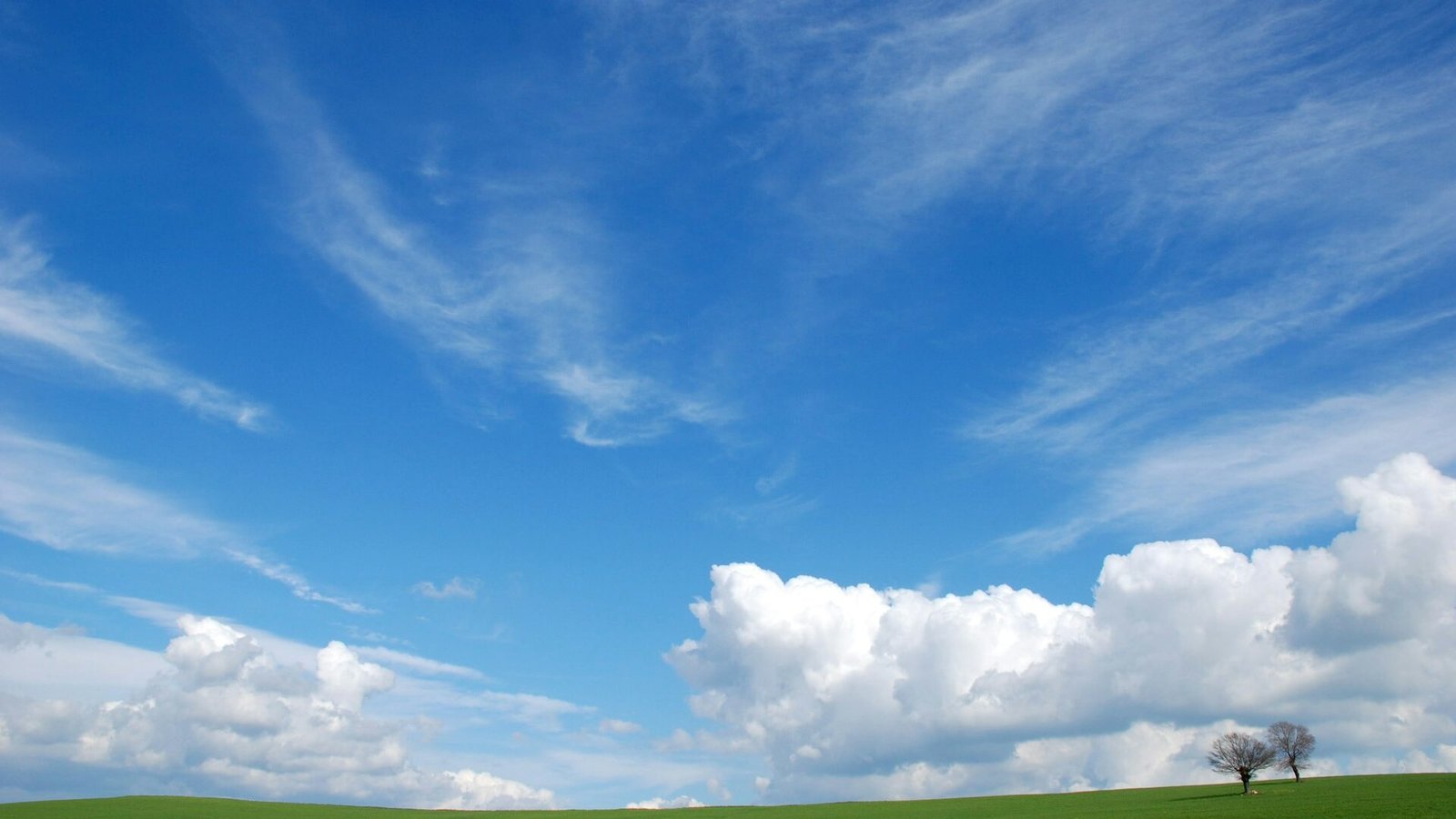
The sky is blue because of a process called Rayleigh scattering. Sunlight looks white but is really a mix of every colour. As it passes through the atmosphere, it hits tiny molecules of nitrogen and oxygen, which scatter short wavelengths of light, like blue, far more strongly than long wavelengths, like red. That scattered blue light bounces around the whole sky and reaches your eyes from every direction, so the sky looks blue.
In this article
Sunlight is made of many colours
In the 1660s, Isaac Newton passed sunlight through a glass prism and showed that it splits into a band of colours: red, orange, yellow, green, blue, indigo and violet. Each colour is light of a different wavelength. Red light has the longest wavelength, around 700 nanometres (billionths of a metre). Blue is shorter, around 450 nanometres, and violet shorter still, around 400.

What is Rayleigh scattering?
When light meets particles much smaller than its own wavelength, such as the gas molecules that make up air, some of it is knocked off in new directions. This is scattering. The British physicist Lord Rayleigh worked out in 1871 that the amount of scattering depends very strongly on wavelength: it rises with the inverse fourth power, so halving the wavelength increases scattering sixteen times.
In practice, that means blue light at about 450 nanometres is scattered roughly five to six times more strongly than red light at 700 nanometres. Red, orange and yellow light mostly travel straight through the air. Blue light is scattered again and again across the sky, so wherever you look, some of it is heading towards you.
Why isn’t the sky violet?
If shorter wavelengths scatter more, violet should win. Three things stop it:
- The Sun gives off less violet light than blue in the first place.
- Some violet is absorbed high in the atmosphere before it can be scattered towards the ground.
- Our eyes are less sensitive to violet. The colour-sensing cells in the eye respond much more strongly to blue, and our brain combines the mix of scattered light into the pale blue we see.
Why are sunsets red and orange?
When the Sun is low on the horizon, its light has to travel through far more of the atmosphere to reach you than at midday. Along that long path, most of the blue and violet light is scattered out of the beam. What is left is the longer-wavelength light: yellow, orange and red.
Dust, smoke and pollution can make sunsets even more vivid, because these larger particles scatter and absorb light in their own ways. After major volcanic eruptions, sunsets around the world can glow unusually red for months.

Why are clouds white?
Cloud droplets are much larger than air molecules, closer in size to the wavelength of light or bigger. Particles that size scatter all colours roughly equally, a process known as Mie scattering. When every colour is scattered by the same amount, the result looks white. Thick storm clouds look grey or dark because they are so dense that little light gets all the way through.
Why does the sky look hazy or white in cities?
On polluted or humid days, the sky over cities such as Lahore and Karachi often looks pale, milky or almost white instead of deep blue. That is because the air is full of larger particles, such as dust, smoke and water droplets, which scatter all colours more evenly, just like clouds do. A deep blue sky is often a sign of clean, dry air, which is why the sky looks so intense in the northern mountains of Gilgit-Baltistan.
Did you know?
On Mars the colours are reversed. Fine reddish dust in the thin Martian air makes the daytime sky look butterscotch or pinkish, while sunsets on Mars glow blue, as photographed by NASA’s rovers.
Is the sky blue on other planets?
It depends on the atmosphere. The Moon has almost no air, so its sky is black even in daytime. Mars has a thin, dusty atmosphere with a tan sky and bluish sunsets. Earth’s sky is blue because our thick atmosphere is mainly made of small nitrogen and oxygen molecules, the ideal size for Rayleigh scattering.
Try it at home
You can see Rayleigh scattering yourself. Fill a clear glass with water, stir in a few drops of milk, and shine a torch through it in a dark room. From the side, the water looks slightly bluish. Look through the glass straight at the torch and the light appears yellow or orange, like a small sunset, because blue has been scattered out of the beam.
Frequently asked questions
Why is the sky blue in simple words?
Air scatters blue light from the Sun much more than red light, so blue light reaches your eyes from all over the sky.
What is Rayleigh scattering?
The scattering of light by particles much smaller than its wavelength, which affects short wavelengths such as blue far more than long ones such as red.
Why is the sky not purple?
The Sun emits less violet light, some is absorbed high in the atmosphere, and our eyes are more sensitive to blue.
Why is the sunset red?
Low sunlight passes through much more air, which scatters away most of the blue and leaves red and orange.
Is the sky blue because it reflects the ocean?
No. It is a common myth. The sky is blue because of scattering in the air; the ocean looks blue partly because it reflects the sky.
Why are clouds white?
Cloud droplets are much larger than air molecules, so they scatter all colours of light roughly equally. Mixed together, those colours look white.
Why is space black?
In space there is almost no air to scatter sunlight towards your eyes, so the sky looks black even when the Sun is shining.
What colour is the sky on Mars?
During the day it looks a dusty orange-brown, because of fine dust in the thin air. Martian sunsets, oddly, look bluish.
Why does the sky look white or grey in Lahore in winter?
Smog and dust particles are larger than air molecules and scatter all colours, washing out the blue. Read our guide to Lahore smog.
Why is the night sky dark?
At night your side of the Earth faces away from the Sun, so there is little light to scatter. Moonlight does scatter blue too, but it is too faint for our eyes to see the colour.